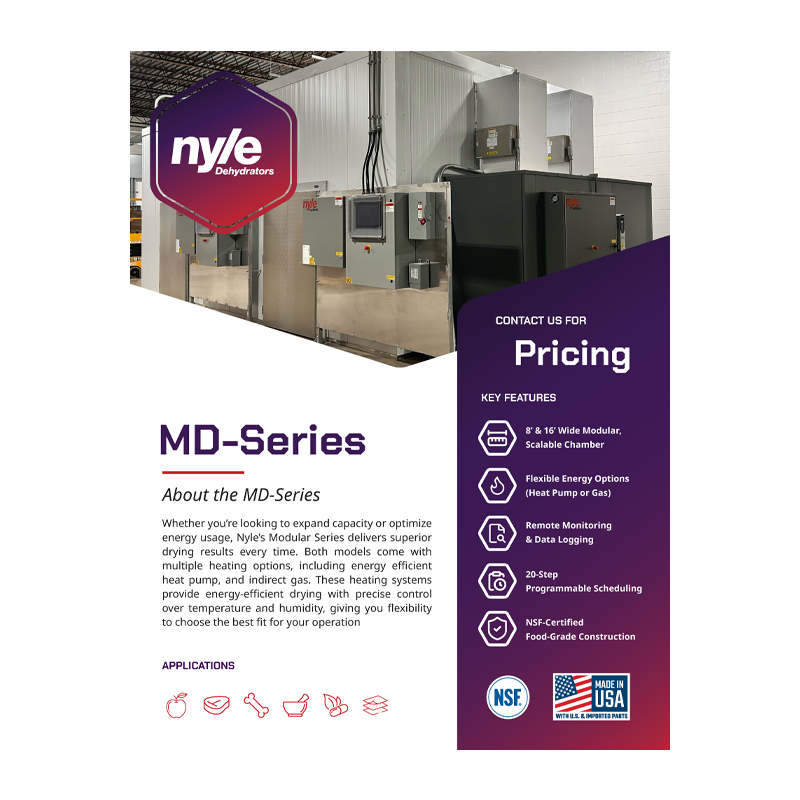
| MD210 | MD220 | |
|---|---|---|
| Rack Capacity | 48 Racks | 96 Racks |
| Tray Capacity | 960 Trays | 1,920 Trays |
| Product Load (Wet lbs) | 4,800–9,600 lbs per batch | 9,600–19,200 lbs per batch |
| Loading Space (D × L × H) | 16'0" D × 14'0" L × 6'0" H | 16'0" D × 28'0" L × 6'0" H |
| Total Footprint (D × L × H) | 21'4" D × 15'0" L × 12'0" H | 21'4" D × 29'0" L × 12'0" H |
| Circulating Fans | Three 36”, 5 HP | Six 36”, 5 HP |
| Vents | 2 | 4 |
| Sensors | 2 | 4 |
| Loading Area Width | 6' wide — dual doors for easy loading/unloading | 6' wide — dual doors for easy loading/unloading |
| Heat Pump Options | DH-145 — 145 lbs/hr water removal DH-225 — 225 lbs/hr water removal | DH-145 — 145 lbs/hr water removal DH-225 — 225 lbs/hr water removal |
| Heat Pump Drying Temp | 80°–160° F (26°–71° C) | 80°–160° F (26°–71° C) |
| Auxiliary Heat (Kill Temp) | 160°–180° F (71°–82° C) | 160°–180° F (71°–82° C) |
| Gas Option | GH6 Indirect Gas-Fired Burner — 600,000 Btu/hr | GH6 Indirect Gas-Fired Burner — 600,000 Btu/hr |
| Gas Drying Temp | 80°–220° F (26°–104° C) | 80°–220° F (26°–104° C) |
| Power Options | 400V Three Phase, 50 Hz 480V Three Phase, 60 Hz | 400V Three Phase, 50 Hz 480V Three Phase, 60 Hz |
| Construction | Food-grade design and construction — NSF certified | Food-grade design and construction — NSF certified |
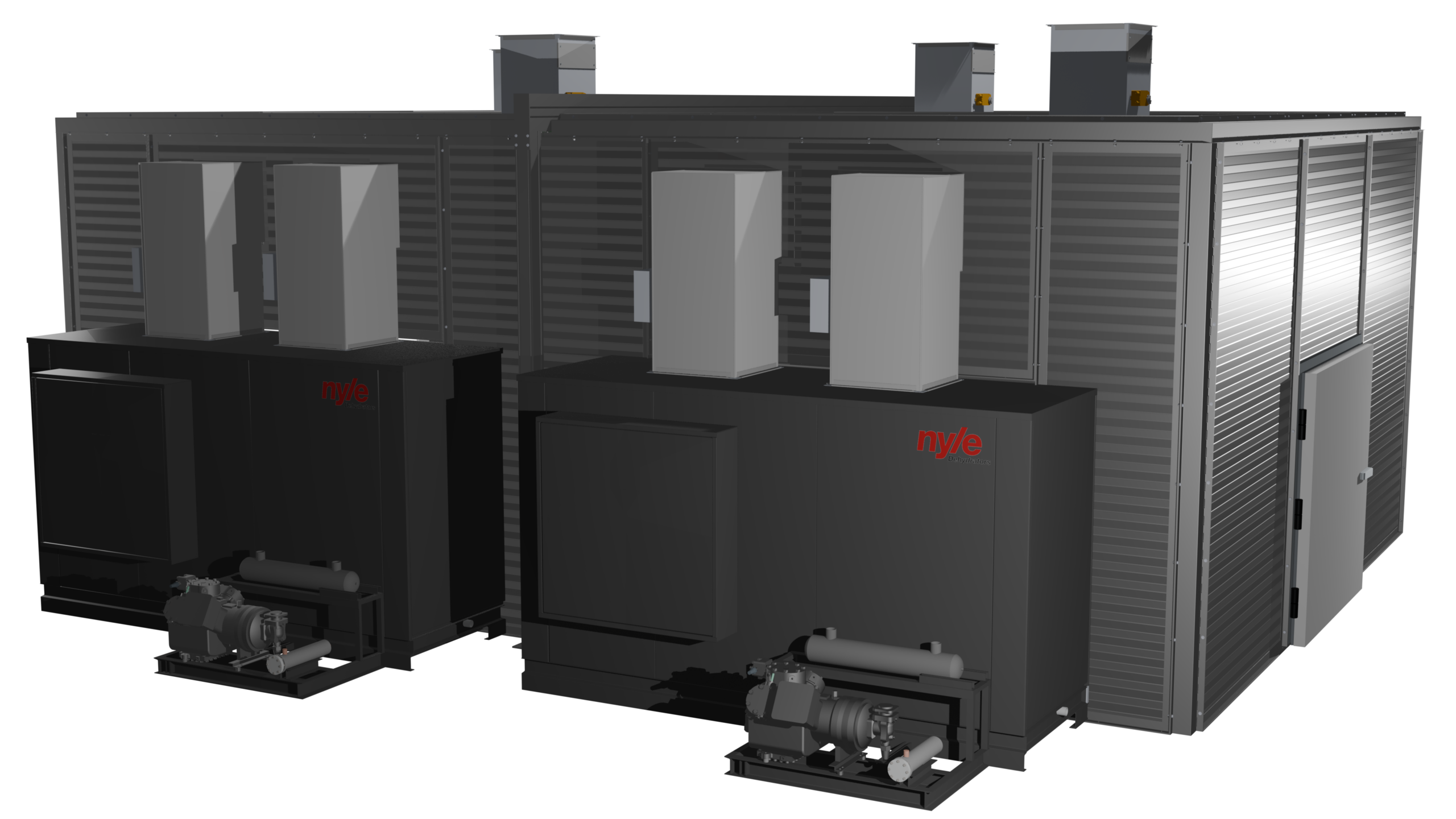
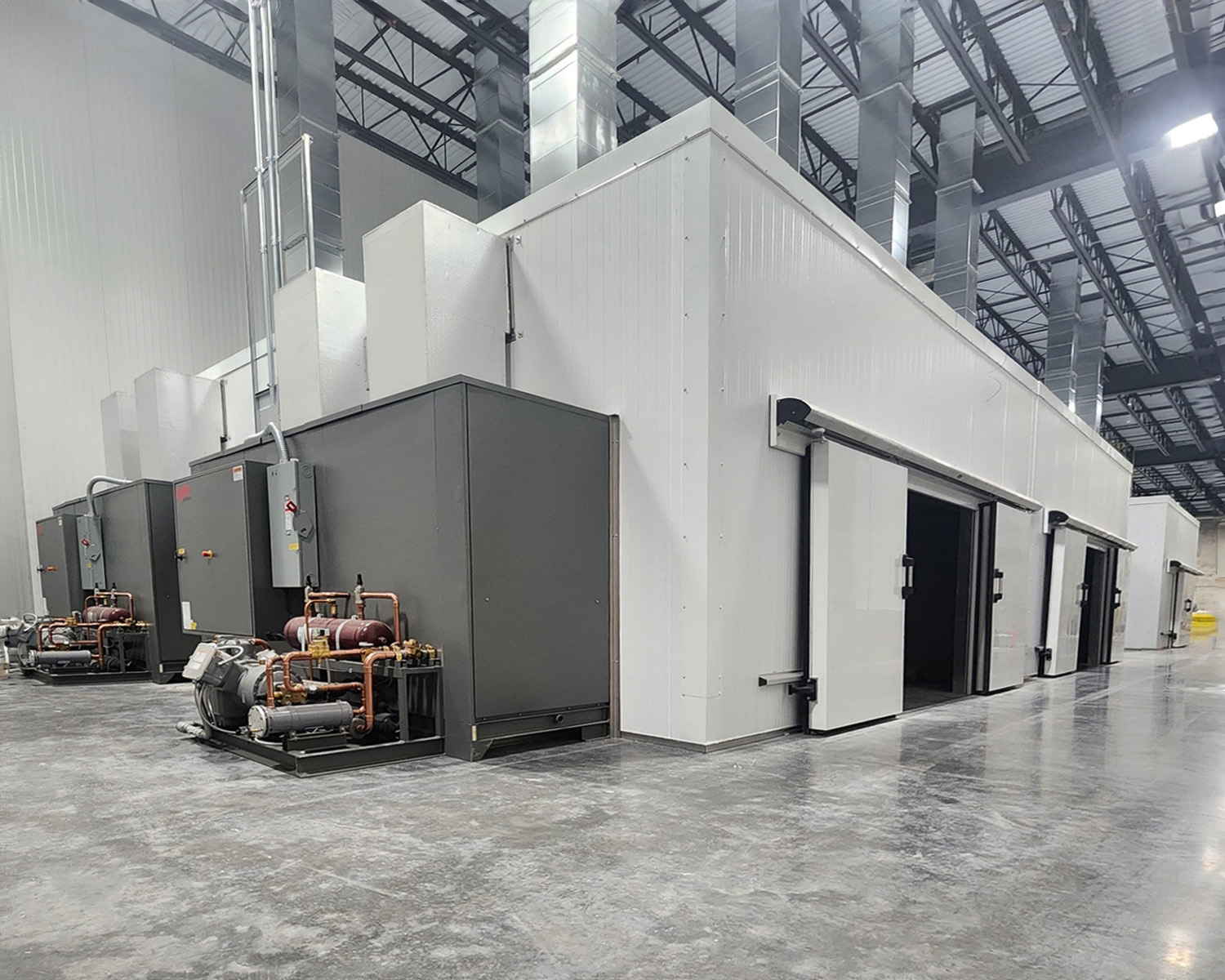
The 200-Series uses a dual-width chamber, 16 feet wide versus 8 feet for the 100-Series, with double doors for increased accessibility and product loading efficiency. That wider footprint roughly doubles rack and tray capacity at equivalent lengths: an MD210 holds 48 racks and 960 trays while an MD110 holds 24 racks and 480 trays at the same 14-foot chamber length. The MD220 scales to 96 racks and 1,920 trays, with a wet product load of 9,600 to 19,200 pounds per batch, making the 200-Series appropriate for operations where the 100-Series capacity has been outgrown or where peak throughput is the primary design constraint.
Like the 100-Series, the 200-Series is available with either a heat pump or an indirect gas-fired heating system. Heat pump configurations use the DH-145 or DH-225 dehumidification unit, delivering 145 or 225 pounds of water removal per hour within an 80°–160°F drying range and auxiliary heat to 180°F. The indirect gas-fired option uses the GH6 burner at 600,000 Btu/hr and expands the temperature range to 220°F. Given the larger chamber volume of the 200-Series, the choice of heating system directly impacts heat recovery time between loads. The gas option's higher output can be an advantage in high-throughput operations running multiple batches per day.
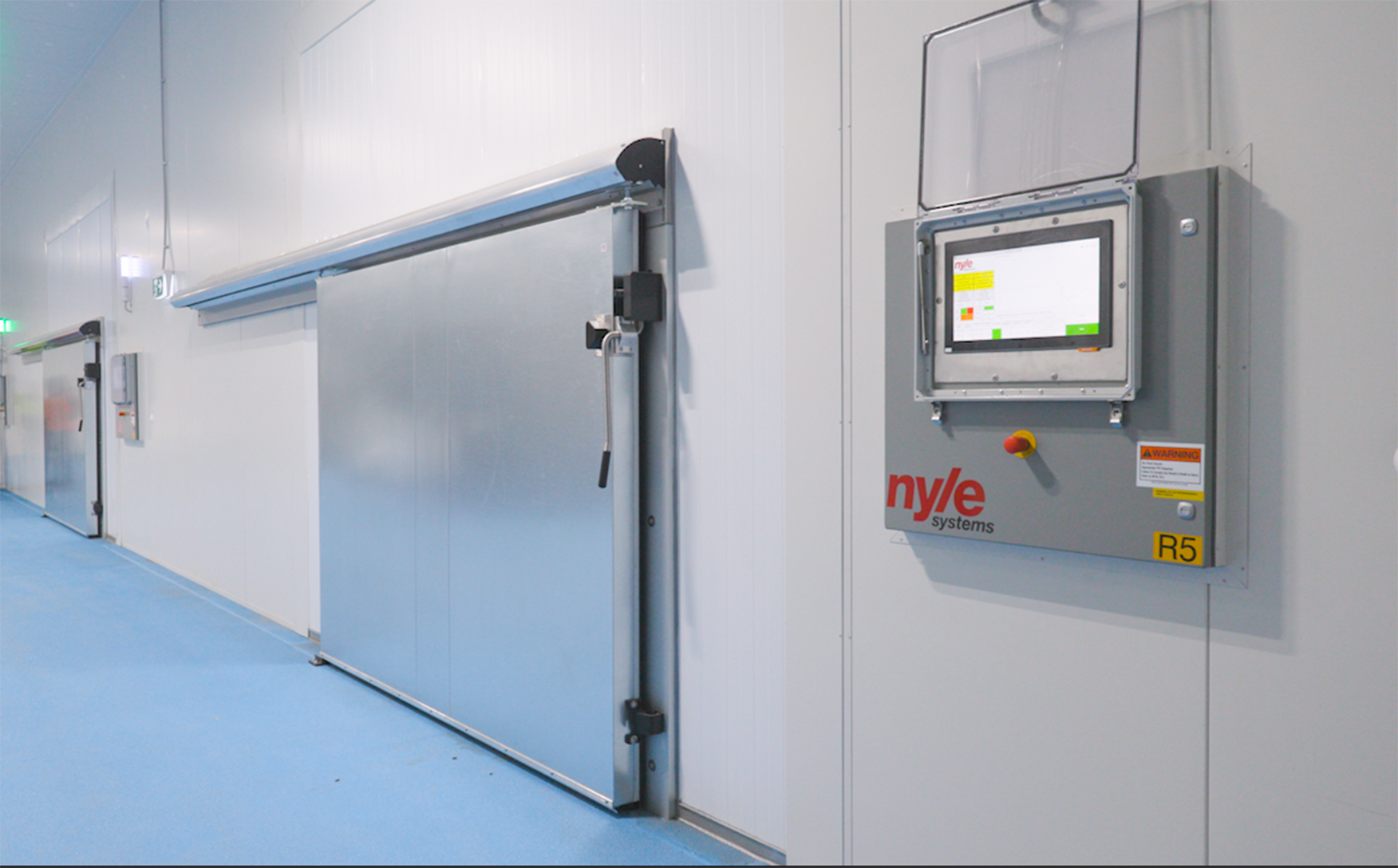
The 200-Series' double-door configuration reflects the practical demands of loading and unloading the chamber. Access on each end of the chamber means the product can be moved in and out more efficiently, which is important when batch loads reach 4,800 to 19,200 pounds of wet product, and loading time is a meaningful factor in daily throughput. The wider chamber also accommodates more racks per row across the full depth of the airflow path, which is why the zone-based control system, with a dedicated Equipment screen per modular zone, gives operators independent visibility into conditions across different sections of the chamber.
In multi-zone MD-Series configurations, the touch-screen controller provides a dedicated Equipment screen for each modular zone of the chamber. This means operators can see temperature, humidity, fan status, and vent conditions on a zone-by-zone basis rather than relying on a single chamber average. Individual probe readings are labeled by zone and position (e.g., "Probe 1A") so operators can identify how conditions vary across a large chamber during a cycle. All probe data is captured in the trend historian and included in the automatic batch log files emailed at the end of each cycle.
Yes. The Validation step mode available on all MD-Series units holds both chamber temperature and relative humidity at defined setpoints for a specified time period before the schedule advances, the core mechanism for documenting kill steps under USDA processing guidelines and HACCP food safety plans. For the gas-fired 200-Series, that validation can occur at temperatures up to 220°F, covering high-temperature protocols that are out of reach for heat pump configurations. Combined with automatic batch log generation and email delivery, the 200-Series provides both the process capability and the documentation infrastructure that regulated food production environments require.