| MD110 | MD120 | |
|---|---|---|
| Rack Capacity | 24 Racks | 48 Racks |
| Tray Capacity | 480 Trays | 960 Trays |
| Product Load (Wet lbs) | 2,400–4,800 lbs per batch | 4,800–9,600 lbs per batch |
| Loading Space (D × L × H) | 8'0" D × 14'0" L × 6'0" H | 8'0" D × 28'0" L × 6'0" H |
| Total Footprint (D × L × H) | 13'4" D × 15'0" L × 12'0" H | 13'4" D × 29'0" L × 12'0" H |
| Circulating Fans | Three 36”, 5 HP | Six 36”, 5 HP |
| Vents | 2 | 4 |
| Sensors | 2 | 4 |
| Loading Area Width | 8' wide | 8' wide |
| Heat Pump Options | DH-145 — 145 lbs/hr water removal DH-225 — 225 lbs/hr water removal | DH-145 — 145 lbs/hr water removal DH-225 — 225 lbs/hr water removal |
| Heat Pump Drying Temp | 80°–160° F (26°–71° C) | 80°–160° F (26°–71° C) |
| Auxiliary Heat (Kill Temp) | 160°–180° F (71°–82° C) | 160°–180° F (71°–82° C) |
| Gas Option | GH6 Indirect Gas-Fired Burner — 600,000 Btu/hr | GH6 Indirect Gas-Fired Burner — 600,000 Btu/hr |
| Gas Drying Temp | 80°–220° F (26°–104° C) | 80°–220° F (26°–104° C) |
| Power Options | 400V Three Phase, 50 Hz 480V Three Phase, 60 Hz | 400V Three Phase, 50 Hz 480V Three Phase, 60 Hz |
| Construction | Food-grade design and construction — NSF certified | Food-grade design and construction — NSF certified |
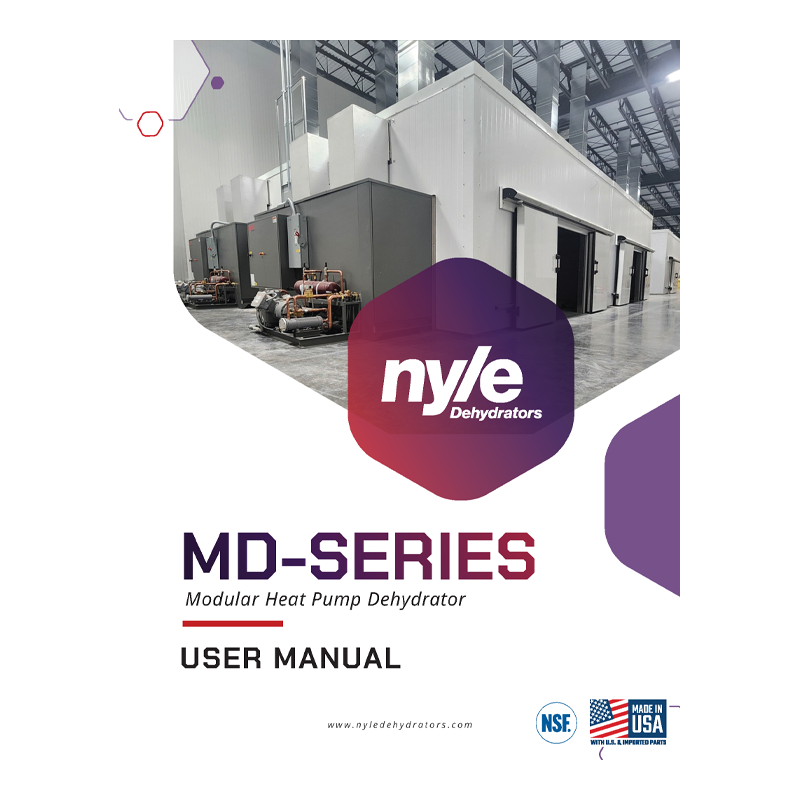
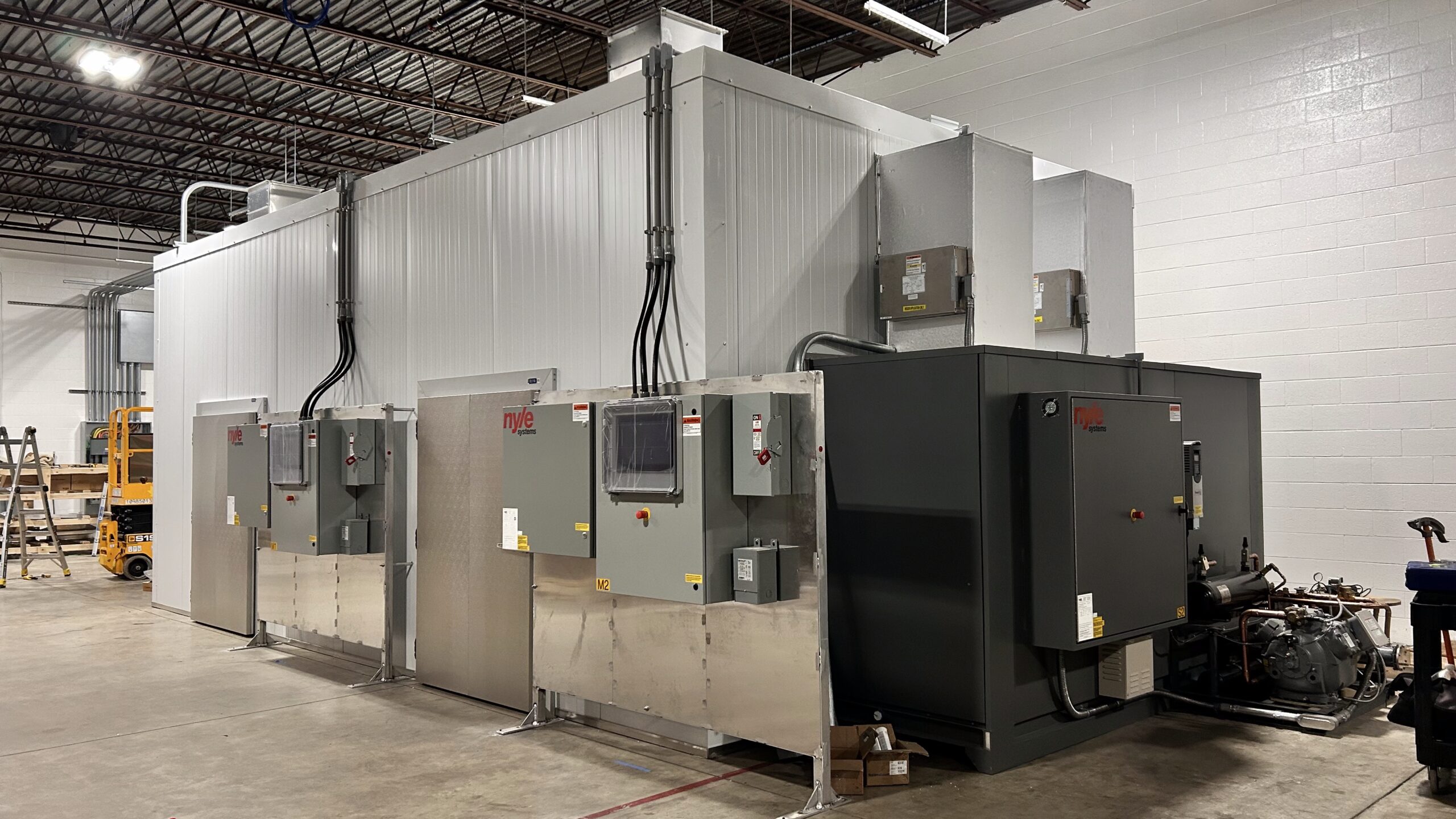
The MD-Series is built around a modular chamber system; the 100-Series uses a single-width, 8-foot loading area that can be configured in 15 & 29 foot lengths. That means an MD110 (24 racks, 480 trays) and an MD120 (48 racks, 960 trays) share the same 8-foot-wide footprint but differ in chamber length.
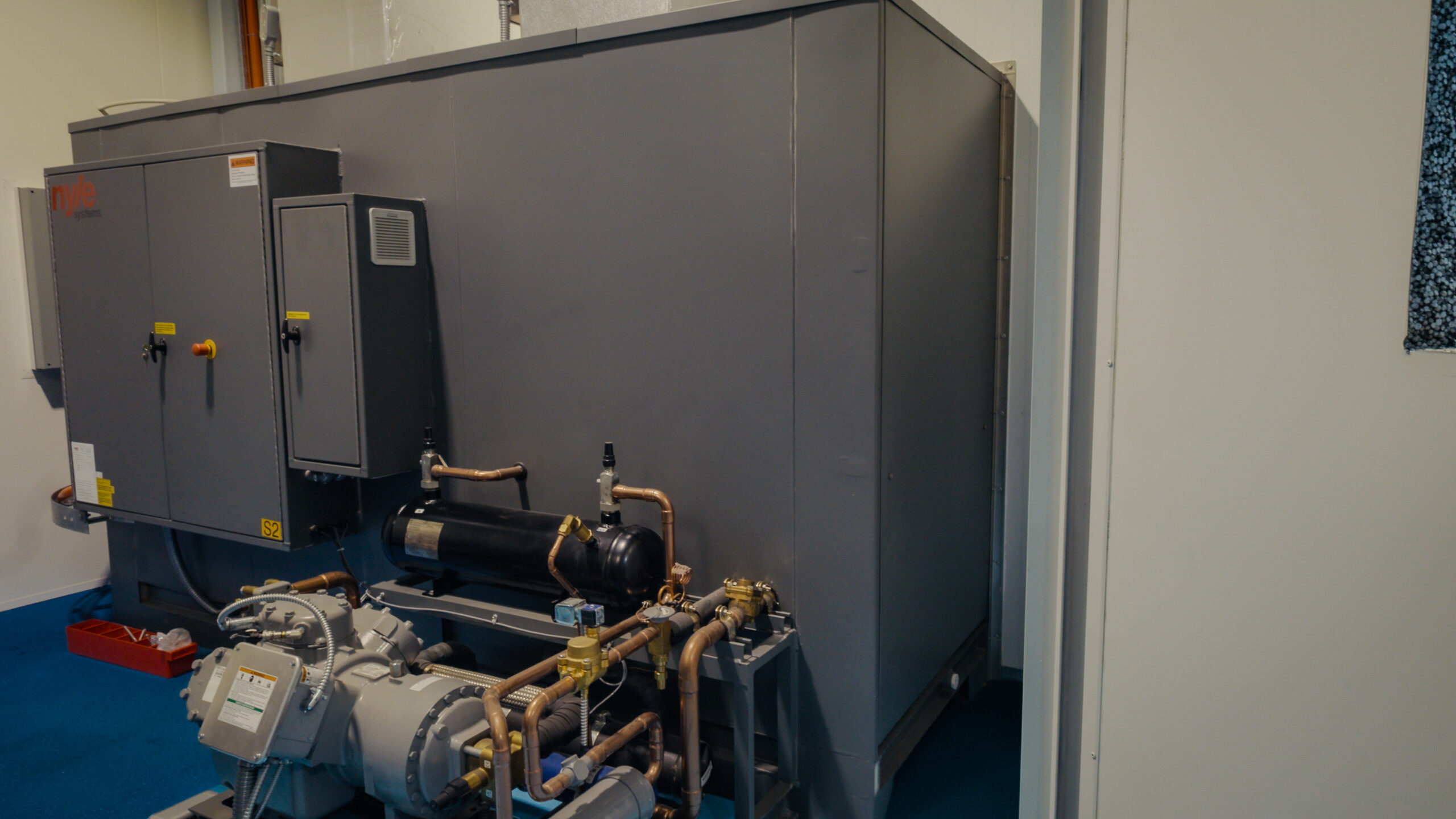
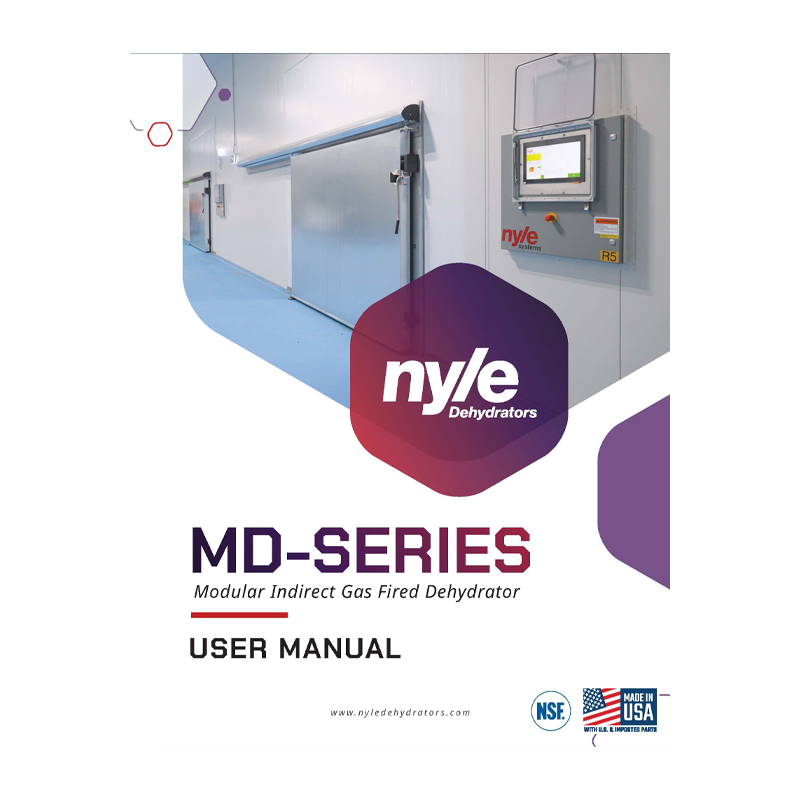
The 100-Series is available with either a heat pump or an indirect gas-fired burner. The heat pump option uses a DH-145 or DH-225 dehumidification unit with water removal rates of 145 or 225 pounds per hour, a drying range of 80°–160°F, and an auxiliary heat mode to 180°F for kill-step applications. The indirect gas-fired option uses a GH6 burner at 600,000 Btu/hr and extends the drying range to 220°F. The right choice depends on your temperature requirements, fuel infrastructure, and energy cost priorities. If your products or food safety protocols require temperatures above 160°F, the gas option is the appropriate path.
The MD-Series scheduler offers 20 programmable steps, twice the step count of Nyle's FD and FDG batch dryers. Each step has its own temperature setpoint, relative humidity target, fan speed (25–100%), fan direction mode (Auto-reverse, Forward, Reverse, or Off), and vent mode (Auto, Manual with a set percentage, or Off). Step advancement is controlled by four modes: Time, Temp, RH, and Validation, the latter holds both temperature and RH at defined setpoints for a specified duration before advancing, supporting USDA and HACCP food safety documentation. Schedules can be saved, loaded, and exported to CSV via USB drive, making it straightforward to transfer proven profiles between units or back them up off-system.
The MD-Series control system records data continuously and automatically generates a drying log file for every completed batch cycle. Those log files are automatically emailed to a recipient list configured on the Information screen, so supervisors and food safety managers can receive batch records without ever going to the production floor. Logs are also stored internally and transferred to a USB drive on the controller. Remote monitoring is available via smartphone, tablet, or computer, giving operators real-time visibility into temperature, humidity, fan status, and active alarms from anywhere on the network.
Both the heat pump and gas-fired versions of the 100-Series include a Validation step mode in the scheduler, which holds chamber temperature and relative humidity at operator-defined setpoints for a set time duration before advancing, the mechanism used to document kill steps under USDA and HACCP plans. The heat pump version reaches 180°F via auxiliary heat mode, which covers most standard meat and jerky kill-step protocols. The gas-fired version extends to 220°F, supporting higher-temperature validation requirements that heat pump systems cannot meet. Automatic batch logging and email delivery of log files further support the documentation requirements of commercial food safety programs.